Vintage Hollywood Pinups Trading Card Set 🍺 Sealed Box, 21st Century Archives, Golden Age Hollywood Pin-Up Art, 1990s Collectible
Vintage Hollywood Pinups Trading Card Set 🍺 Sealed Box, 21st Century Archives, Golden Age Hollywood Pin-Up Art, 1990s Collectible
Couldn't load pickup availability
What if this is the box that holds her? 💋
There was a particular kind of magic in cracking open a fresh box of cards back before you could look anything up before you'd even paid for it. You didn't know what was inside — you just knew that somewhere, tucked between fifty ordinary cards, there might be her. That randomly inserted Marilyn Monroe card was the whole game: the little jolt of "what if this is the one" that turned an afternoon hobby into something closer to treasure hunting. This box has never been opened. Whatever that possibility is worth to you, it's still sealed inside, exactly as it left the factory floor.
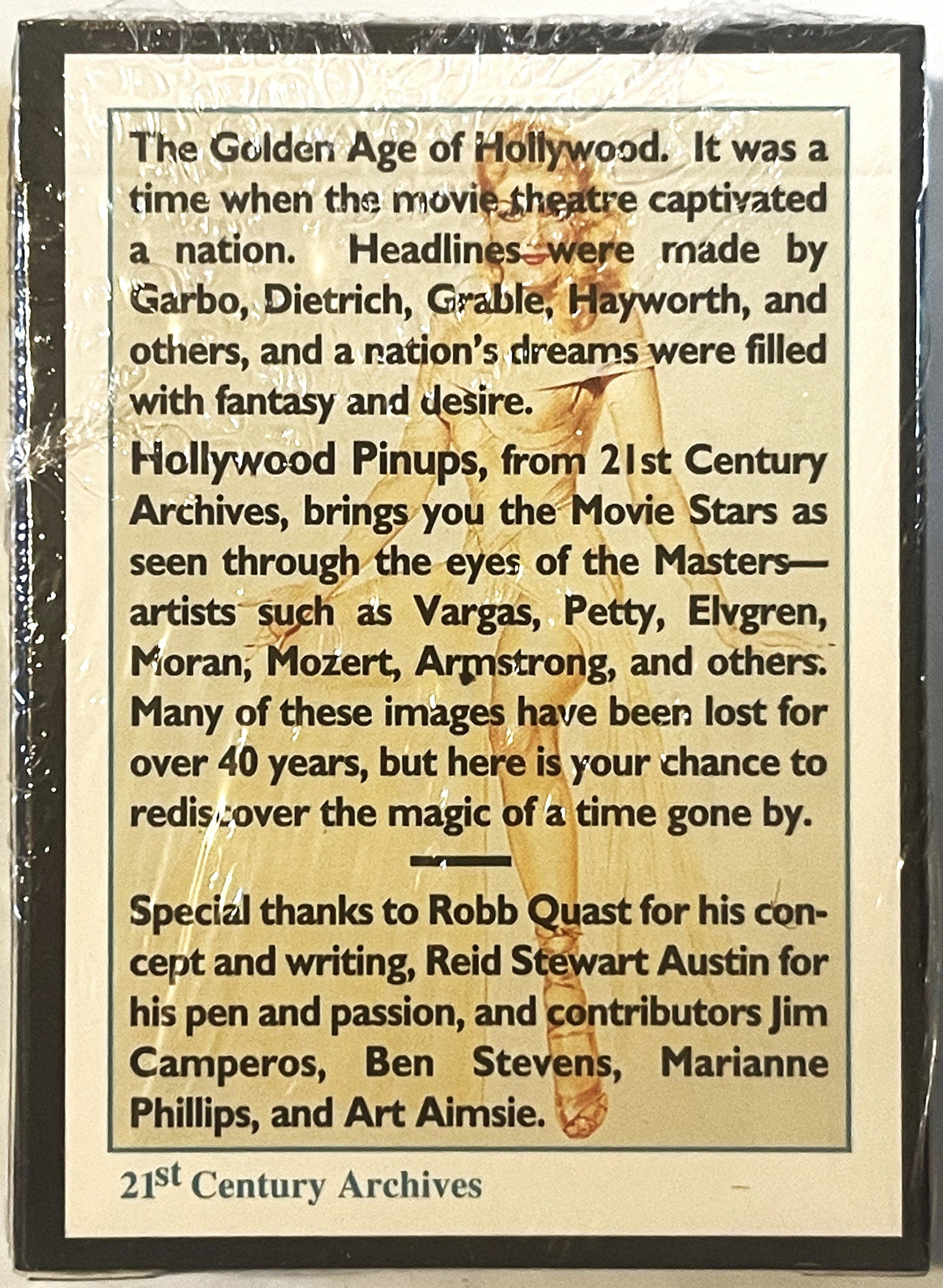
This is a factory-sealed Hollywood Pinups trading card set, subtitled "Movie Legends from the Golden Age of Hollywood," produced by 21st Century Archives sometime in the 1990s. Each card in the set measures a standard 2.5 x 3.5 inches, printed in color offset lithography in a warm, coordinated palette of golden yellow, sepia brown, cream, sage green, red, and black — the same palette dressing the box itself. The box front carries an original pin-up illustration: a redheaded beauty in a strapless cream gown, a sequined sage-green bra top, and a red sash swept across her hip, rendered in the loose, glowing brushwork of classic calendar art. Lower right, a small engraved temple-and-column logo marks it as a 21st Century Archives release. The back panel repeats the same figure in a faded sepia wash, laid beneath the company's own printed account of the set's concept, its credited artists, and its writers. This is New Old Stock — a sealed box, never opened, a genuine survivor of a very particular moment in both Hollywood nostalgia and the trading card hobby.
🏛️ A Boutique Card House Built on Rediscovery
21st Century Archives was never one of the trading card giants of its era — it was something smaller and stranger, a niche American publisher that carved out its own corner of the non-sports card boom by going backward instead of forward. While the bigger names of the hobby were chasing the newest rookie or the newest blockbuster, this company went digging through the vaults of American commercial illustration, licensing and reprinting pin-up artwork that had genuinely dropped out of public circulation for decades. Their own printed history says it plainly, right there on the back of this very box: "Many of these images have been lost for over 40 years, but here is your chance to rediscover the magic of a time gone by." That was the whole pitch, and for a hobby built entirely on nostalgia, it was a good one.
Hollywood Pinups sat alongside a small, tightly-knit family of releases from the same publisher — a Vargas Girls set built entirely around the work of Alberto Vargas, a Gil Elvgren Pin-Up set with its own "Bathing Beauties" and "Beach Girls" mail-in chase subsets, a bolder "Pinups Uncovered" release, and a set devoted to Bettie Page. Trading card catalogs and auction records that track this company's short-lived output consistently place its documented run within a tight three-to-four-year window in the early-to-mid 1990s — squarely inside what collectors now remember as the peak years of the "non-sport" specialty card scene, when boutique publishers like this one were racing to license every archive of vintage art and photography they could find before the wider hobby cooled off. No record of a release before or after that window has surfaced, which makes this small run of pin-up sets essentially the company's entire documented life's work.
🖌️ The Masters Behind the Images
The box names its artists directly — Vargas, Petty, Elvgren, Moran, Mozert, Armstrong — and every one of them was a real, working titan of American commercial illustration, not a Hollywood studio artist at all. Rolf Armstrong, often called the father of the calendar girl by illustration historians, built his reputation painting glowing, luminous women for calendar houses starting in the late 1910s. Gil Elvgren spent decades as one of the most prolific and imitated pin-up painters in the business, his idealized American women becoming a genre unto themselves. Earl Moran worked the same calendar circuit through the 1950s, and — as the next section tells — painted one particular young model whose face would later become the most famous in the world. George Petty, a Chicago illustrator, became a national name when Esquire magazine launched in the 1930s; his "Petty Girl" gatefolds are widely credited with popularizing the magazine centerfold format itself. Alberto Vargas, born in Peru and settled in New York, created the wartime "Vargas Girls" for Esquire — images so widely circulated among American servicemen that they were painted directly onto the noses of Allied aircraft. Zoë Mozert, one of the era's few prominent female pin-up artists, trained in Pennsylvania and became known especially for her wartime "Victory Girls" work. Together their names represent the actual engine room of American glamour art in the 20th century — and this box was built as a tribute to all of them at once.
🏙️ St. Paul, Minnesota — The Real Hometown of the Calendar Girl
Here's the twist most collectors never expect: the real "place" behind so much of this artwork isn't Hollywood at all. It's St. Paul, Minnesota. Two rival calendar printing houses were headquartered there — Brown & Bigelow, founded in the 1890s and grown into one of the country's dominant producers of promotional calendars and novelties, and its cross-town competitor, the Louis F. Dow Company. Rolf Armstrong painted for Brown & Bigelow for decades. Gil Elvgren painted calendar art for the company from the mid-1940s until the early 1970s. Earl Moran supplied its pin-up calendar lines through the 1950s. This was, in a very real sense, a Midwestern art factory dressed up in Hollywood glamour.
The rivalry between the two firms produced one of the pin-up world's more colorful documented episodes. Elvgren actually started his career at Louis F. Dow in the late 1930s, painting roughly sixty images for the company, before Brown & Bigelow lured him away with a better contract. Art dealers who've traced the two companies' competition — including the Grapefruit Moon Gallery, which specializes in this exact history — describe it as an "arms race in printing, promotion, and talent acquisition" between the two St. Paul houses. According to that same trail of research, when Elvgren left, a spurned Louis F. Dow reportedly had another artist repaint the backgrounds and costumes on his leftover canvases — keeping his original poses and faces intact — so the company could keep selling the same images under new titles without paying him another dime, since Dow still legally owned the canvases. It's the kind of backroom hustle that never made the papers at the time, but has been pieced together since by the collectors and dealers who've spent careers tracking this exact corner of American illustration — and it's a genuine piece of the same industry that put brushes in the hands of the very artists named on this box.
💋 Norma Jeane Before Marilyn — The Chase Card's True Story
The box's promise — "Special Marilyn Card Randomly Inserted, Collect All Five!" — isn't just a marketing hook. It connects to a genuinely documented piece of Hollywood pre-history. Collectors have long traced the inserted "Blonde Bombshells" cards from this release to specific artists: one insert pairs a Greta Garbo card by Rolf Armstrong alongside a "Norma Jean" card credited to Earl Moran. That name matters, because Earl Moran's connection to Marilyn Monroe is real and well documented. After relocating to Hollywood in the mid-1940s, Moran was sent a young model named Norma Jeane Dougherty by the Blue Book modeling agency — and for the next several years, she posed for him regularly, becoming, by his own account, one of his favorite subjects. Long before "Marilyn Monroe" existed as a name the world knew, she was standing in a calendar artist's studio, being painted the same way Garbo, Grable, and every other glamour icon of the day was painted. Collectors who chased this set in its day recall five different Marilyn-themed insert cards scattered across the run — a "collect all five" hunt that turned every sealed box into its own small gamble, and this one has never been opened to find out what it holds.
✍️ The Historian Who Gave It Words
The back of the box thanks a handful of contributors — Robb Quast for concept and writing, Jim Camperos, Ben Stevens, Marianne Phillips, and Art Aimsie among them — but one name credited "for his pen and passion" carries real, verifiable weight: Reid Stewart Austin. Austin is a published, credentialed pin-up art historian, author of an authorized biography of Alberto Vargas, of "Varga: The Esquire Years," and of a study of George Petty's classic pin-up art with a foreword by Hugh Hefner himself. He also wrote "The Best of Gil Elvgren: Calendar Art from the Brown & Bigelow Archives" — published directly by Brown & Bigelow, the very St. Paul calendar house whose artists fill this box. In other words, the man credited with this set's text wasn't a hired copywriter guessing at the history — he was one of the few people alive with a genuine working relationship to the actual archives this card set was built to celebrate. (One name worth noting without overclaiming: a Marianne Phillips signed a contemporaneous pin-up calendar from the same period titled "Art from the Golden Age of Glamour." Whether it's the same Marianne Phillips credited here can't be confirmed — but the coincidence in timing is worth recording.)
🎥 The Golden Age the Box Remembers
The stars the box invokes by name — Garbo, Dietrich, Grable, Hayworth — represent two overlapping chapters of the studio-system era this set is built to honor. Garbo and Dietrich were the mysterious, European-inflected icons of 1930s studio glamour. Grable and Hayworth became the defining pin-up faces of the Second World War: Betty Grable's swimsuit photograph is remembered as the single most requested pin-up image among American servicemen, while Rita Hayworth's own famous photograph made her arguably Grable's only rival in popularity with the troops — an image so iconic it was later stenciled onto a wartime test device at Bikini Atoll. That wartime pin-up culture is the real bridge between studio glamour photography and the illustrated calendar tradition of Elvgren, Armstrong, Moran, and Vargas — both trafficked in the same nationwide appetite for images of idealized American women, and this card set was built decades later to gather all of it under one roof.
🖼️ Display Ideas
- 🎞️ Shelved beside a classic film library or a home theater setup for anyone who lives for old Hollywood
- 🖼️ Displayed sealed as-is alongside a framed pin-up print or vintage movie poster for a matched glamour wall
- 🍸 Set out on a bar cart or retro lounge shelf as a conversation-starting piece of period color
- 💄 Placed on a vanity or dressing table for anyone building a classic glamour-themed room
- 📚 Grouped with coffee-table books on Vargas, Petty, or Elvgren for a shelf devoted to American pin-up art
- 🏛️ Kept sealed in a display case as a preserved artifact of the 1990s non-sport card hobby itself
🎁 Who Collects These
This box tends to find its way to a specific kind of collector — the pin-up and glamour art enthusiast building out a shelf of Vargas, Petty, and Elvgren material; the classic film buff who wants a physical piece of Golden Age Hollywood beyond the posters and lobby cards everyone already has; the Marilyn Monroe completist chasing every documented appearance of her image, including the ones that predate her stardom; the non-sport trading card hobbyist who remembers the boutique card boom of the early 1990s firsthand; and the gift-giver looking for something genuinely different for a classic-film lover — a sealed piece of nostalgia that's never been opened, and never will be, until they choose to.
❓ FAQ
Is the special Marilyn card guaranteed to be inside this box?
No — the box itself states it plainly: the Marilyn card is "randomly inserted." Insert cards like this were distributed unevenly across the print run by design, which is exactly what made chasing them part of the hobby's original appeal. This box remains sealed, so its exact contents haven't been revealed.
What size are the cards?
Each card measures the standard trading card size of 2.5 x 3.5 inches, printed in color offset lithography.
Who are the artists represented in this set?
The box credits Alberto Vargas, George Petty, Gil Elvgren, Earl Moran, Zoë Mozert, and Rolf Armstrong among its featured "Masters" — six of the defining names in 20th-century American pin-up and calendar illustration.
Is this box sealed?
Yes — this is New Old Stock, a factory-sealed box that has never been opened.
How many cards make up the base set?
The documented base run for this release is fifty cards, with special insert cards distributed randomly throughout the print run.
Is the "Marilyn" card an official photograph of Marilyn Monroe?
Based on the artists credited to this release's insert cards, the Marilyn-themed card traces to Earl Moran's original pin-up painting of a young Norma Jeane Dougherty — created during her real, documented modeling sessions with Moran years before she became a movie star — rather than a licensed studio photograph.
Who wrote the history printed on the box?
The writing is credited to Robb Quast for concept, with text credited to Reid Stewart Austin — a published pin-up art historian with authored books on Alberto Vargas and George Petty, and a Brown & Bigelow-published history of Gil Elvgren's calendar work.
🔎 More From The Vintage & Antique Gifts Archive